

Nobody Asked What Matters to You.
That’s Why You’re Burned Out.
Prove Me Wrong.
You’re pissed. Not out loud, not in a way anyone would notice, probably not even in a way you’d admit to yourself on most days. But I’m asking you to admit it now, and I’m telling you it’s okay to feel it. Because here’s what I’ve seen in 36 years, sitting across from people who have built things, led things, invested themselves into things: businesses, teams, organizations, relationships, memberships, careers, wealth building, leadership.
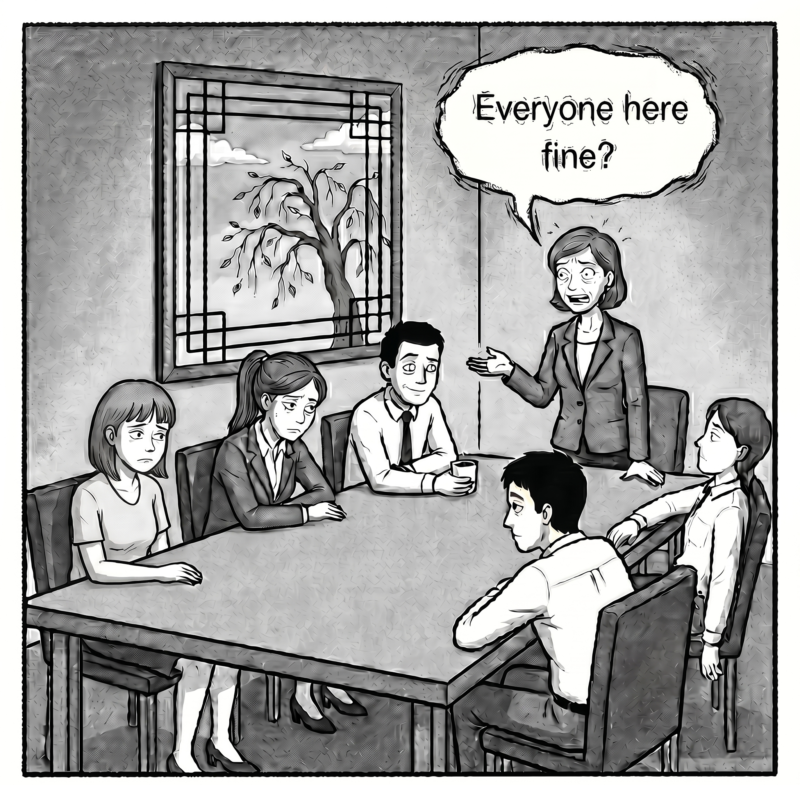
The ones who are the most depleted are rarely the ones who look it. They are, in fact, the ones who look fine. Who perform fine. Who’ve gotten so good at fine that they’ve stopped noticing the pathology of it.
Maybe you won’t say it out loud, but I will. Under the “I’m fine”; under the calendar that’s full and the bank account that’s okay and the business that’s running and the membership that’s technically working and the team that’s doing their jobs, something inside is SO FED UP with fine.
The team that, when it comes down to it, doesn’t give much of a damn. The industry that commoditizes what you’ve spent years building, that is full of shit, that sets the bar low. The organization you joined that doesn’t deliver what it promised. The wealth that doesn’t make you feel as happy as you thought it would. The leadership that feels hollow. You’re pissed at all of it. And you’re pissed at yourself too, because you can’t figure out why, with everything you are, do, and have, you only feel fine.
Fine can be torture. And it is.

Burnout and Disengagement Are Not the Same Thing, But They’re Connected
“Fine.”
Torture like that has a name. And though some might call it burnout, that’s not what it is.
Burnout is a symptom. It’s your body’s intelligent feedback telling you the truth about the real problem. And it feels awful. Disengagement, especially when you try to fight it, feels like living hell.
What most burnout advice completely misses is understanding the link between burnout and disengagement. You become disengaged because what’s fine is not important enough for you to get up for. It’s just not worth it.
What is fine exhausts you.
It’s boring. It’s not worth engaging with. And, yet, you push yourself. You expect yourself to be resilient. To push past what you have no taste for. To be productive. Effective. Efficient. Successful.
And, so, you live with fine.
That’s why you feel disengaged.
This is not a criticism of you. It’s not an accusation that you don’t care enough. Fine is not good enough. And your body knows it. So, it tells you. It disengages for you.
Burnout is feedback.
It’s feedback that you want to care more.
Read that again. Burnout is feedback. It’s your own intelligence telling you that what people are asking of you every day is meaningless…or at least not meaningful enough. It doesn’t mean you’re weak, not trying hard enough, or ungrateful. When you live in a world that is not designed to ask what matters to you, but to ask what you can produce: produce, produce, produce, pay, pay, pay, give, give, give. The healthiest, most normal, safest thing in the world to do is to disengage. It’s as if your body and mind have decided to save your energy for the right things; no longer to be spent on what really does not matter.
The word fine is one word that handily hides the disengaged spirit.
Burnout is disengagement.
It doesn’t happen because you’re lacking, or because you have a packed day, or because you have bad boundaries, or because you’re doing anything wrong. It happens because you work for things that make no sense, that violate what actually matters to you. When nobody in charge is asking you the right questions, you forget to ask them yourself. Then the collective buzz sweeps you away, and you forget why you want to do anything.
However, during the time you’re preoccupied by the buzz, your values don’t disappear. They are part of you. So, while you are busy chasing whatever it is someone told you is great, your values rest in a kind of hibernation. It can be a long cold winter. Then, when they can’t stay still a moment longer, they wake up, and suddenly, you just can’t ignore them.
Disengagement can seem sudden. Especially when you are accustomed to being engaged. When you are used to feeling satisfied. Every day, people tell me how uncomfortable it is. It disturbs their sleep, appetite, mood, and many aspects of their health.
When you withdraw from anything habitual, it can feel alarming.
Disengagement hits people hard.
You might not realize how pissed you are. You might be more than pissed. Enraged, even. There’s something about being trapped that brings out the beast in us. And yet no one would know. Maybe you wouldn’t even recognize it. Even if it was eating you up.
It’s happened to the best of us. We’ve gone all in. And now we’re out of juice. We’ve learned to live with the fury. And when we can’t tolerate it anymore, we’re taught to call our disengagement burnout, as if something is wrong with us.
But it’s not.
Disengagement.
People, companies, and communities ask me to help them improve their engagement. They want to re-engage in their own lives, in their relationships, with their employees, their customers, their members, their organizations. They want everyone to be more engaged. Why? Because disengagement is expensive. Very expensive. No one can stand the feeling of disengagement. Not individuals. Not employers, leaders, founders, boards, companies, communities, associations, or governments. No one can bear the cost of disengagement, whether it’s personal or at the enterprise level.
I show them the way out of the tangled mess of disengagement. And the light out of that tunnel is meaning. I show them where meaning exists and how to use it. I show them how it keeps getting overlooked and how to stop doing that. Most importantly, I show them the truth: When meaning is attended to, it solves the problems that actually matter.
When meaning leads, everything else follows.
Let me show you how. At every level, from a single human being to a billion-dollar organization, meaning is what holds it together and allows it to evolve.
Burnout Is Not What They Told You (And Why Rest Won’t Fix It)
If anyone tells you to go on vacation, improve boundary setting, adopt self-care practices, start daily meditation, or improve sleep quality, as if the problem is simply that your battery is low and you just need to plug in. Walk away. That is not your problem. You do need sleep and rest, but no amount of it will refill a battery that is draining into the wrong outlet.
Burnout is not the opposite of rest.
It’s the opposite of engagement.
It’s the opposite of feeling like something is worth your time,
energy, attention, effort, money, blood, sweat, and tears.
Engagement Is What Love Looks Like in Real Life
I want to be clear about this. Engagement does not equal stimulation. Engagement is not a full calendar, an exciting project, a new initiative, or a dopamine hit from a keynote speaker. Stimulation is often a band aid for burnout, and it leaves the wound to fester.
Hundreds of people have asked me what engagement is. I’m using that word because it’s become regular industry vernacular that’s supposed to describe people who are happy at work and in their organizations. I don’t like that word. It’s overused and overwhelmingly misunderstood. But we’re stuck with it. The word I’d rather use is love. Hang in there. I’m going to be practical about this word “love.” Stick with me.
Engagement is alignment with meaning.
When you’re engaged, you are in love. Think of it the way we think of couples who get engaged. They are gaining energy from investing their time, effort, attention, and creativity; from investing themselves into something that embodies and reflects what they hold dear. This is all about embracing value. That is why I call it love.
When you’re engaged, you feel like you fit, because what you’re doing reflects who you actually are. Your effort can be demanding, but it feels worth it. Recovery feels natural and swift. You sleep deeply and wake up wanting to continue with the life you’re living.
When you’re not engaged, you’re not in love. You’re going through the motions, performing, and being competent. Maybe you’re working hard at something that means nothing to you, and every hour you give costs twice what it gives back. This is not a question of being tired. It’s a question of depletion. And no amount of rest will ever fill that gap, because it’s not a gap from overwork. It’s a gap from miswork.
Some Things Drain You. Some Things Feed You.
That’s the premise no one names. Any system will consume you for its own benefit.
- If it’s not the right fit for you, you become the fuel. When you get used up, you feel burned out. If you feel a sense of disengagement, it’s a message to you, a warning that you are being consumed.
- If it is the right fit for you, it will become your fuel. You won’t feel used up, or burned out. You’ll feel engaged. Your body will give you the energy you need and want to continue to be satisfied.
In both cases, the system you are in is only an environment. It is not designed to make sure you are satisfied. It’s got to survive itself. When you are gone, the system will move on to the next person. You leave either richer or poorer for it. You leave either burned out or fired up. Burned out if it was meaningless. Fired up if it was meaningful.
Pay attention to the intelligent feedback your own beautiful body gives you. Through feelings of disengagement, through feelings of burnout, it tells you that you’re being consumed. Through feelings of engagement, through feelings of enthusiasm, it tells you that you are the one getting fueled up.
Signs of Burnout and Disengagement at Every Scale
It Happens to Everyone. Everywhere. Every Time.
This is not a metaphor. It’s a universal truth. The same pattern repeats at every scale, from the micro to the macro.
Individual level
At the individual level, the signs of burnout and disengagement look like this: anxiousness that won’t resolve, insomnia, irritability, emotional withdrawal, decreasing vitality, self-doubt, numbness, and carelessness. Clinically, it shows up as telomere shortening, the biological marker of accelerated aging. Your chromosomes literally contract. Burnout is telling you you’ve drifted from your purpose. Funny how the body tells the truth. It makes you ask:
Does this have any meaning for me? Is what I am doing even close to fulfilling my values? Does any of this really matter to me?
Company level
At the company level, burnout is disengaged employees, disloyal customers, low initiative, high turnover, effort-filled commoditization, frustrating stagnancy, and eventually, bankruptcy.
Think of bankruptcy as burnout on a balance sheet. It’s what happens when people inside a company have spent enough of their life force doing work that doesn’t fit their values, led by people who never thought to ask what those values were. And it’s what happens when customers have spent enough of their money to know they’re not going to spend it where their values aren’t getting recognized or fulfilled. Of course that’s a company that has no profit. Profit is the right to expand evolutionary growth. No company earns that privilege when it can’t recognize and fulfill the values of its people and grow on the fuel of values fulfilled.
And yet, despite all the money spent on best practices and SOPs, there’s rarely anything set up to look for alignment between what matters to the company and what matters to the employees and customers. Is anyone even asking?
Community level
At the community level (associations, memberships, and networks), burnout is disengaged professional staff, disinterested member volunteers, and apathetic members: high attrition, regular dropout, low attendance, lack of advocacy, poor referrals, and cultural deadening. An organization that used to feel alive will feel like it’s dying. Events happen but people don’t come. People pay their dues but ghost the programming. Getting feedback is like pulling teeth. Members don’t step up to volunteer. Leadership works hard at new member development. Existing members leave. And yet nobody asks, “Do we know what we believe matters?” Did this ever have meaning for our members? Have we even been trying to find out what their values are? Are our programs actually fulfilling those values? Are we paying any attention to what matters to them?
Three scales. One pattern. The mechanism is identical every time.
Life force flows through you, through your relationships, through your teams and employees, through your customers and members, through your company, through your community, and through your culture. When it flows, when people love what’s happening because it has meaning to them, because it adds value to their lives, because it’s worth their time, energy, attention, effort, and money, engagement soars. That’s when there is personal growth and happiness, strong relationships, company profit, and community expansion. That’s when the culture is strong. Because values are what make a culture exist.
When life force cannot flow and stagnates instead, people are intelligently withdrawing the valuable resource of their life force. They’re looking to put it elsewhere.
Life force is love. If you love what you do, if the people in your life love what they’re doing, if your employees love what they’re building, if the company loves what it values and loves fulfilling the shared values of its customers, if the community loves its members and what it offers, people feel it. They feel like they fit. So they engage, they refer, and they can’t resist. They want to advocate for the organization, for the company, and for the community because they feel advocated for.
Without that life force, the relationships decay. That’s what you’re calling burnout. That’s what you’re calling disengagement. It’s a decay of personal self-respect, a decay that leads to damaged relationships, low profit, conditions for bankruptcy, stagnant growth, regular turnover, and attrition. It’s called by many words, but the disease remains the same.
The Root Cause of Burnout and Disengagement
The Root Error Everyone Is Making
At every scale, the same mistake is being made again and again. People are chasing excitement or stimulation, or trying to fulfill expectations that don’t align with them, instead of aligning with meaning and making sure there’s “a fit”.
People chase a new opportunity, a new certification, a new venture, an exciting relationship without asking, “Does this matter to me? Is it a fit for me?”
They spend their time, energy, attention, effort, and money doing something someone else has told them to do without checking it against their own value system. So no wonder they feel like a seal balancing a ball on its nose in the middle of a circus. When the novelty wears off and what’s left is just the daily grind of performance (something that was never truly aligned), that being-pissed-off state emerges. Maybe it happens slowly, and then it’s the norm. They don’t know what to call it. So they say everything is just fine.
Burnout is the proof of the misallocation of life assets.
Nothing more and nothing less.
Companies make this error all the time. A company will chase a new product, a new market, new branding, new hires without asking what meaning this holds for the person making it, working for it, or buying it. They don’t make sure that employees and customers are connecting their service or product to their own values. Instead, they get involved in shiny object syndrome. They try to meet or beat the competition. The result is compliant employees, defensive management, unmotivated leadership, low sales, unsatisfied customers…and a bill they pay every quarter without being able to see what they’re actually paying for.
Communities (associations, memberships, networking organizations) make the same error. They think more offerings, more events, more polish, more programming, doing what their competitors are doing, commoditizing their products will help them grow. They forget to stop and ask, “What meaning do we hold as sacred? And does this hold for our members?” So new members come in and existing members drop out.
It’s called the leaky bucket.
Leadership aims the blame outward at members who aren’t engaged, rather than inward at the design that was never built around meaning or identifying what the members actually care about.

What Burnout and Disengagement Are Costing You – The Numbers
Let’s talk about the scale of this before we go further. Employee disengagement is not a culture problem. It’s a math problem.
The research is clear. Disengaged employees cost organizations between 18 and 34 percent of their annual salary in lost productivity, turnover costs, errors, absenteeism, and the heavy drag of people who show up but have already checked out. Run that formula against your own headcount. Take the number of people in your company or on your team. Estimate conservatively. Say one-third of them are disengaged, because the national averages are worse than that. Multiply that by 18 percent of the total payroll of those disengaged individuals.
That number you just got? That’s what it costs you annually to run a system that never asks what matters to the people inside it. Every payroll cycle, every month, every year. Like clockwork. The money just goes down the drain.
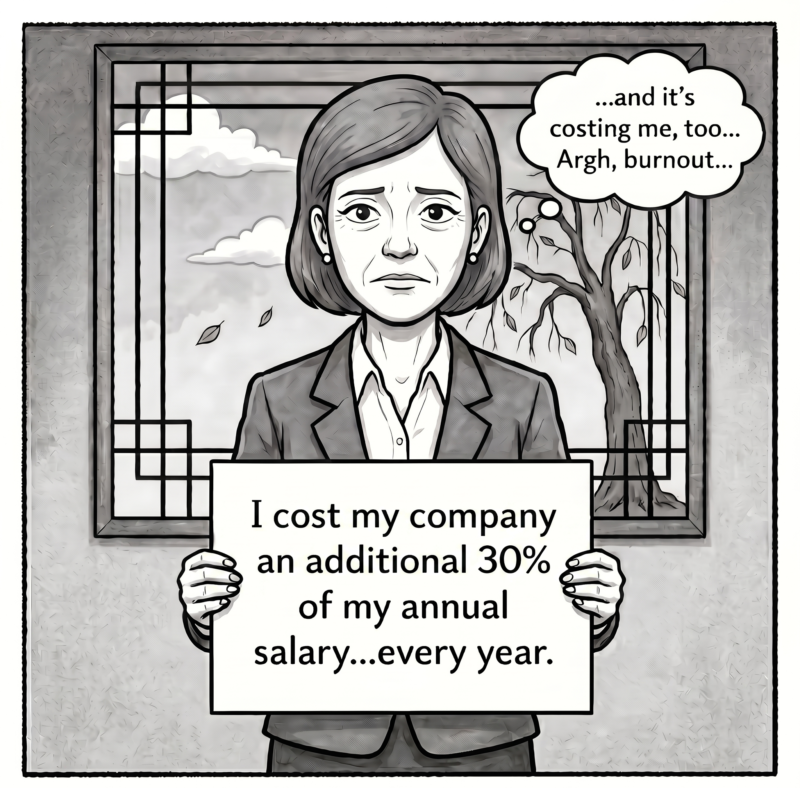
It’s not because you’re bad or your people are bad, nor because you’re a bad leader. It’s because nobody built the system around what matters to anybody, and so nothing matters to anybody.
Systems that aren’t built around meaning will
eventually drain the people inside them,
and they will fail.
The same math applies in communities, even though the currency is different. Rather than the cost adding up in salaries, the cost is attrition, volunteer dropout, leadership fatigue, and the death of community culture. It may not be tracked on a P&L the same way it is in a for-profit company, but it is just as real. Communities want to grow in number and expand their budgets so they can offer more to their members so that they have more economic power to build a better organization. When the bucket leaks, it makes expansion impossible.
A community might ignore this and keep doing what they’re doing: adding programming, chasing new members, and blaming the ones who left. They might call it a tough year. They might wait it out, looking for new leadership.
But keep in mind: there is no staying the same. An organization is either green and growing or ripe and rotting.
There are only two directions. The only question is which one you’re headed.
Engagement is a solvable problem. But it has a specific code; that’s the part that most people miss.
The DNA of Engagement
Engagement is not an accident. It does not emerge from good intentions, smiles, or a busy calendar.
I call this system the DNA of Engagement. Not because it looks like DNA, but because it operates like DNA. There is a pattern. There is a code and an internal logic. You cannot violate it without consequences. When you let it run, the results are predictable: Engagement happens.
Here it is:
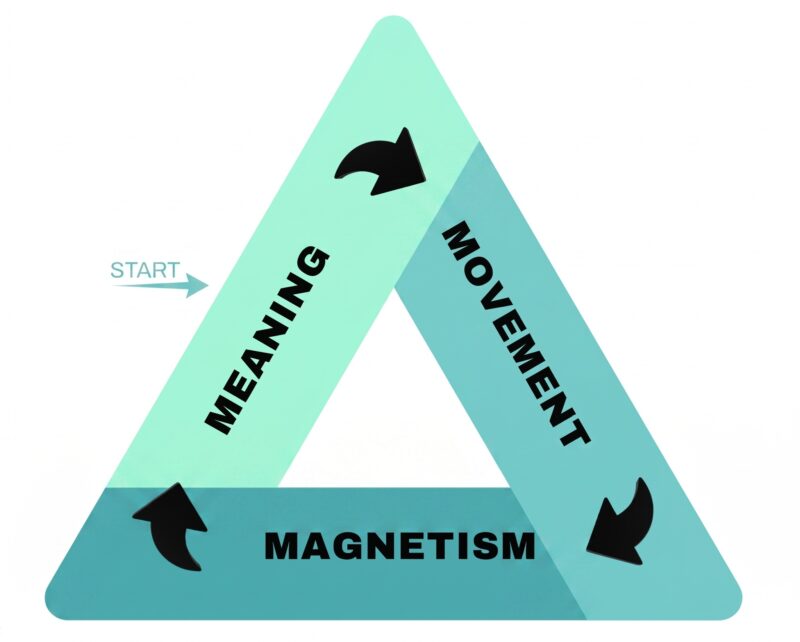
Get the sequence wrong, and the results are equally predictable…and not good.
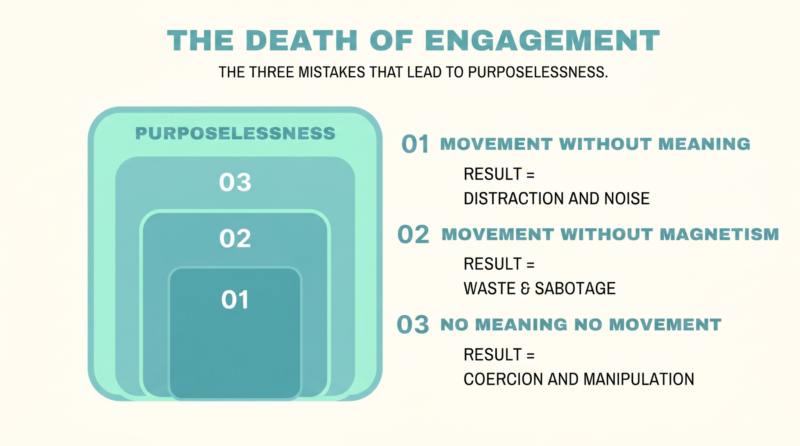
If you ignore the order, and try to make yourself move without meaning, or try to be magnetic without meaning, it will be as if you are lifting a heavy load every minute of the day. It’s exhausting. It won’t work easily or simply, ever.
It gets worse: What happens in you spreads to your company, your association, your organization…and your family and community. What happens with you happens to your culture.
10 Ways Burnout and Disengagement Get Engineered Into Your System
Here are the ten most common ways the code gets corrupted. These are the patterns that scramble the sequence and reliably produce noise, stagnation, churn, and eventually decay.
1. Output-First Design
You build the program, product, calendar, or KPI dashboard before you ask what matters. You try to retrofit meaning.
2. Shiny Object Syndrome
You chase novelty to escape the discomfort of low meaning. Activity rises. Meaning stays absent. People feel the mismatch.
3. Incentive Stacking
You try to buy magnetism. Points, perks, contests, referral bounties. You get short spikes, then fatigue and contempt.
4. Extraction Culture
The system asks: What can we get from you? Not: What matters to you? This erodes self-respect and corrodes trust.
5. Performance Theatre
You mistake visible motion for real movement: busyness, meetings, updates, alignment calls. Activity replaces progress. Busyness creates noise and fatigue.
6. Proxy Meaning
You borrow meaning from slogans, mission statements, trends, or borrowed values. It sounds noble. It does not feel true. Mismatches and chaos abound.
7. Compliance as a Success Metric
You count attendance, completion, logins, hours, but ignore advocacy. You reward checkbox behavior and call it health.
8. Bait-and-Switch Promises
The invitation implies meaning. The lived experience delivers something else. That converts potential advocacy into warning and backlash. People who feel that betrayal don’t just leave. They campaign against you.
9. Misfit Tolerance
You keep people in roles, teams, and communities where they do not fit because of allegiance to the clique or it is otherwise convenient. But Misfit stops movement even when meaning exists.
10. Feedback Suppression
You punish candor, ignore signals, or numb the truth with positivity. When people stop telling you what matters, you don’t get the feedback you need. The code immediately corrupted, and with it, movement and magnetism.
Every one of these patterns minimizes or skips meaning. Every one of them starts in the middle or at the end of the code to try to work backward. And every one of them produces the same result: noise, stagnation, churn, and eventually burnout and disengagement.
Now let’s break down the three parts of the DNA of Engagement Code.
The Three Parts of the DNA of Engagement Code
Meaning
Meaning = Meaning and Fit
How often are you asking this question to yourself, to the people in your life, to your employees, to your customers, and to your members: Does this matter? Does this matter to me, to my values? To you, to your values? Is this worth my time, energy, attention, effort, money? Is it worth yours? Or is this worth my customer’s time, energy, attention, effort, money? What is someone getting out of this? What makes them say: This is worth it?
This is where the code begins.
If meaning is the root, vigor is the sap flow. Everything grows from here.
Something that has deep meaning for you is what makes you get up in the morning and want to be alive. Fit is the match between what you are being asked to invest in and who you actually are, what you actually value. When meaning and fit are high, you naturally engage. You make time, come early, and show up prepared. You prioritize wisely and keep thinking about things even between meetings because you can’t resist what has meaning to you. That’s how it is for everyone. Just think about it.
When meaning and fit are low,
even the best programming, offerings, and resources
just feel like noise.
It’s not because the content is bad. It’s just because you’re not interested. If it wasn’t designed with your values in mind, it won’t be received.
Most people and systems skip this step entirely.
For the individual, it’s common to get wrapped up in the idea of what you should like. If some authority figure once told you what’s important, it might have been enough for you to forget what you actually believe is important. It happens all the time.
In companies and communities, offerings are commonly designed first based on a good idea or independent research done by leadership or an external expert or agency, without considering their own customers’, teams’, or members’ feedback. Then they hope the right people will show up. Wow, are they confused when the results are disappointing.
The problem is that the order is wrong, at both the individual and the collective level.
Meaning has to come first.
You have to ask yourself first. What do I value? Does this match? Does it matter to me? These questions are the foundation of your own life’s choices. If you are not feeling happy or satisfied, if you’re feeling burned out or disengaged, it’s because you’ve lost touch with your own values. Your body and mind have withdrawn your life force from what really doesn’t matter. That feeling of burnout is not something to complain about. It’s something to accept as data. Trust yourself.
For a company, you can’t just hire an industry expert to speak for your customers. You can’t create an avatar and put words in the avatar’s mouth. You have to do something that feels almost crazy: Take the time to ask. Ask questions about value, about worth, about what matters. And then you have to listen, figure out if you share those values, and then, if they do, you must fulfill them.
You can build the best life ever, the best company ever, the best community ever, when it’s built on meaning and fit. That truth begins with you. You cannot overlook it at any level: individual, relationship, team, company, community, organization.
Allow yourself to discover the truth by asking. Ask yourself. And then be courageous enough to ask your clients and customers and let them tell you the truth. But it starts with you making the ask.
Movement
Movement = Vigor and Aliveness
Ask yourself: How much vigor do I feel when I am doing, being, or having what matters to me? Does it make me feel alive? Ask it about the people in your life. Ask it about your employees, your customers, your teams, your members. And ask them directly: How alive do you feel because of this product, this service, this event, this encounter, this expense of your time, energy, attention, effort, and money?
Vigor is not hype. It’s not excitement or motivation. Also not enthusiasm performed for the room. It’s a rich, beautiful energy that flows whenever you are doing something that aligns with what you value. When your values are being fulfilled, you feel alive. You feel like whatever you’re doing is worthwhile. When your values are not being fulfilled, you feel drained. Your body knows before your brain does. You may not be able to name why, but your body is reliable that way. It points you in a direction. It withdraws your energy from the thing that’s not serving you, so you can point it somewhere that matters.
But here’s what happens instead.
You’re told to anesthetize yourself.
Anesthetize = Numb Yourself = “Shut up.”
If you don’t feel happy, have a glass of wine. Take a nap. Take a painkiller or take a gummy. You’re trained to numb yourself rather than listen to the intelligent feedback of your own body.
The numbing comes in different forms in companies too: a new initiative, a team event, time off, a rebrand.
Anything that distracts you is a numbing agent for the short term.
For time-poor, nervous-system-strained entrepreneurs, leaders, and professionals, vigor is non-negotiable. If participation costs more energy than it returns, if you leave meetings feeling worse than when you arrived, if you finish a workday without being able to point to a single thing you felt was worth your time and effort, of course you will withdraw. You will find a way out of whatever it is you are doing. Not because you’re lazy, but because your system is designed to be self-protecting. It’s intelligent behavior to withdraw yourself from something that has no meaning. Just like there are physical dangers to your body, there are existential dangers to your soul. You have only one life. You cannot spend it on things that don’t matter.
If meaning is the root, vigor is the sap flow. When the root is healthy, the sap flows. When the root is crushed, no amount of stimulation will produce vigor. You can imitate the performance of aliveness, but you cannot manufacture aliveness itself.
Magnetism
Magnetism = Advocacy and Referability
Have you ever been so enthusiastic that you’ve dragged someone you care about to an event, to a doctor, to a show, to an athletic event? Insisted she take a class or buy a product? Talked incessantly about something you loved? Heartily recommended an expert, coach, teacher? There’s a reason you became an advocate for that thing or person. There’s a reason you forced your best friend to go, or your colleagues to attend. When you believe in something, you cannot resist sharing it, because it fulfills your values. You want to tell the world. The magnetism is irresistible.
So ask yourself now: Would you stand up and speak out for what you’re doing right now? Would you invite someone you respect to join you? Would you grab your best friends and say this is the best thing in the world?
Magnetism, the thing that results in advocacy and referability, is the highest expression of engagement and the most honest diagnostic anyone has. When someone has meaning and fit and vigor and aliveness, magnetism emerges without prompting. People just can’t help themselves. They want to drag other people to experience what’s fulfilling. They put their name behind things without hesitation. You’ve done this in your life. When you have really believed in something and it fulfilled your values, you’ve brought people towards it.
On the other hand, this happens…
When fit is present but movement is not, you go quiet. You’ve been there too. That’s when you don’t advocate and you don’t refer, because you feel like even though something has meaning, what’s offered doesn’t really work. Somehow it has drained you. Of course you won’t refer. You might even, if someone asked you directly, warn that person to stay away. And sometimes, if you have felt that meaning and fit were there and then found out a company or community was run poorly, or it seemed like a bait and switch, you might have been offended enough that you campaigned against that organization. No one takes kindly to having their time, energy, attention, effort, or money taken for granted or used carelessly.
Magnetism is surplus vitality. It’s boundless energy. It can only emerge when meaning and movement are already real. That’s why you cannot manufacture it with referral programs, incentives, or gamified point systems. You can insist on the behavior, but you cannot manufacture the conviction behind it. And don’t think you’ll trick anyone. People feel the difference immediately. Remember what I said: The body knows the truth before the brain even does.
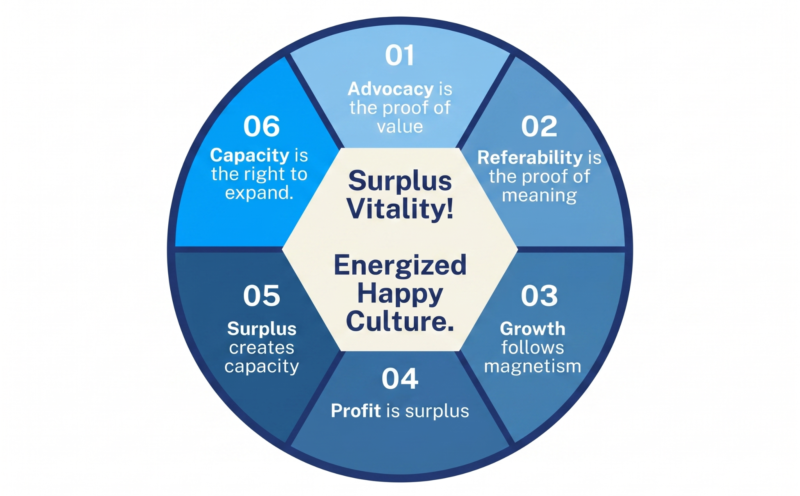
It’s a flywheel that starts with meaning, leads to movement, and results in magnetism. Magnetism creates expansion. Expansion creates the conditions for deeper meaning. Which generates more movement. Which generates more magnetism.
When the flywheel runs clean, it is self-sustaining.
This is not a feeling. It is a regenerative system.
Combination Locks Work When the Sequence is Right
This pattern, this code, is not random. It’s a sequence that unlocks everything.
Think of any time when you have known the combination to your regular, everyday combination lock. You knew the numbers, but you spun the dial in the wrong order, so the lock didn’t open. You tried again. Still nothing. You tried a different way. Still nothing. So you start flipping the dial faster, harder, with more effort, pulling on the lock. And still nothing. You know you’ve got the numbers right, but you can’t figure out the right order. Eventually you throw your hands in the air and walk away.
That’s not a you problem. That was a sequence problem. You knew the code. You just got mixed up on the order.
The sequence matters.

When the Code Breaks
Meaning. Movement. Magnetism. That’s the code. When it runs clean, you have engagement. When any part of the sequence breaks down, you have one of the many faces of burnout: in a body, in a company, in a community. Name it what you will: burnout, disengagement, bankruptcy. It’s all the same.
The breaks are diagnosable.
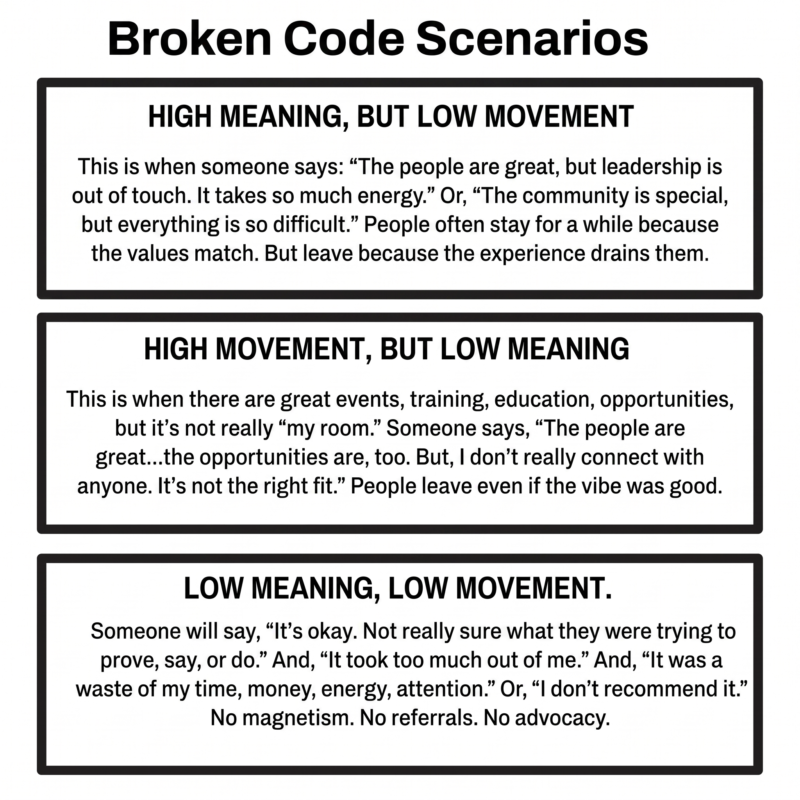
None of these are engagement problems. They are design problems. They are fixable, but only if you’re willing to admit what they are.
Compliance Is Not Engagement
This is where many well-intentioned leaders fail…companies, communities, and coaches alike.
They try to drive magnetism before movement exists. They try to increase movement without establishing meaning. Then they add programming, incentives, events, perks, recognition programs, layering more and more activity onto a foundation that was never built around meaning. It doesn’t work. It can’t work and it won’t work.
You cannot pull someone through a keyhole and make it feel like love. Meaning and fit must be self-recognized. You can’t tell anyone that something is good and then simply expect engagement to follow. Maybe you’ll get compliance for a while. And from a distance, it might look like engagement. A person might show up, nod, check a box. But it won’t be engagement. It will be the opposite of engagement in its essence and its practical outcome.
Compliance is engagement stripped of its vitality.
Read that again. Put it on your wall and never forget it.
If someone is going through the motions, that person is not only already on the way out. It is already done.
The order is fixed. Meaning produces movement. Movement produces magnetism. If you reverse the order, the system will strain. Then break.
What Engagement Actually Requires
Instead of asking how do we get people to be more engaged, start asking the questions that produce engagement.
The magic word to remember is ASK.
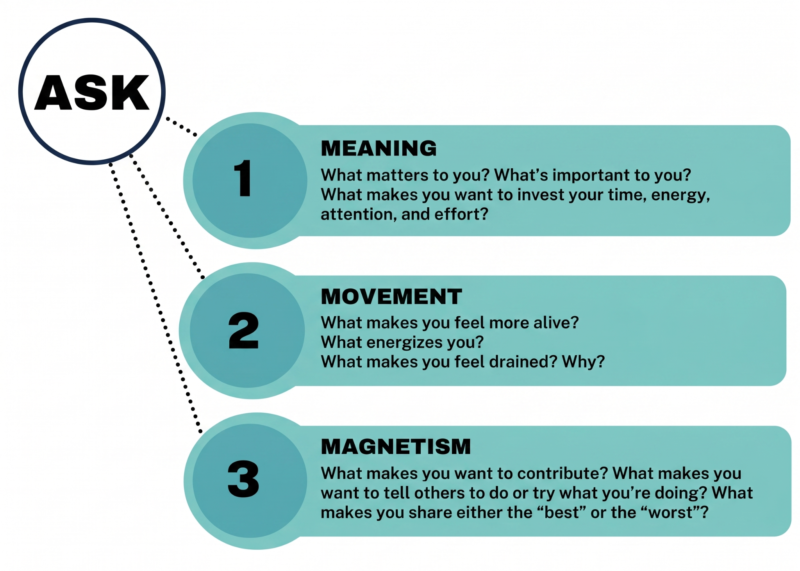
Most people have never been asked these questions. In fact, it’s likely they’ve never asked themselves. And you can’t give what you’ve never received. When you ask yourself these questions, something shifts. When you ask other people, something shifts for them too. Their nervous system responds. Being seen that way is rare enough to be startling.
When people are seen, they begin to engage. Not because they’re obligated to, but because their investment starts to feel like it’s worth making.
Being seen is the very first step of meaning.
When people understand their own values clearly enough to deploy their life assets strategically, they give fully to what fits and decline what doesn’t. They don’t burn out because they are fired up. There is purpose and meaning to their efforts and their attention. It’s easy for them to give. They would do it for free, because what matters gives them intrinsic fulfillment.
When a company knows its values and discovers its employees’ and customers’ values, not just their skill sets or their income bracket, disengagement ceases to be a topic. Advocacy becomes normal.
When a community knows its own values and discovers what its members value and designs experiences around those things, the code runs clean. And the community grows.
Stop Engineering Burnout
Here’s the part nobody wants to hear.
The burnout you feel, the burnout in your company, the burnout in your organization…it’s not happening to you. It’s happening because you’re allowing it. You might even be building it, one values-blind decision at a time.
Every time you forget your own values, every time you forget your company’s or organization’s values, you set yourself up for failure. It’s your values that people use to filter themselves in or out of your life, your company, your organization. It’s your values that you use to filter in and out the who’s and the what’s and the how’s of your life.
Every time you design your life, your team meeting, your product, or your service without putting your values front and center, there’s no meaning to it. You are engineering disengagement. You may think you don’t have time for such folly as talking about meaning, and so it stays in the background or gets assumed. When meaning is front and center, everything runs smoother. The results are better. Energy goes up. You need less discipline, fewer band aids, less oversight. You have fewer mistakes with less effort, more fun, and more profit.
Every time you create a program, event, or initiative based on what you think people should want, without asking what they actually value, you are engineering burnout, dropout, and bankruptcy.
Every time you measure engagement by attendance instead of by advocacy and referrals, which tell the true quality of meaning in the room, you’re counting compliance and calling it health.
You’re not doing this on purpose. You’re doing it because no one taught you the other way, because most systems you’ve been handed were built around output, attendance, and activity; not around the meaning that makes all of those things possible and sustainable.
But now you know. Which means from here, every decision you make without asking what matters is a choice.
The question is no longer whether you are doing what you’re supposed to do, or whether your employees are hitting their numbers, or whether your members are engaged enough. The question is whether you’re building conditions where engagement is even possible.
How to Overcome Burnout and Disengagement
Where to Start
Start with yourself.
Do you know what you value? Have you ever stopped to think about what has meaning for you, what would fit in your life, what would be the perfect fit for you? You’ve got to get past the self-flagellation and the linguistic norm of just saying you’re burned out. You are a human being and you are full of light. You have a unique sense of what’s important in this world and what matters. That is life force flowing through you, and it has a place. It’s part of the circuitry of our universe. Something you have to honor and what sets you apart. It’s what makes you perfect for a role, a job, an accomplishment. Start with yourself. Know what you value. Be able to say it out loud.
Then look at everything around you.
Look at your relationships.
Are the people closest to you seeing you clearly? Are you seeing them? Is there meaning in what you’re building together?
Look at your company.
Does your company know what its values are? Not what’s on a mission statement. What does it actually live by? What does it consider worthwhile? Or what does it love and live for? There’s no wrong answer. Whatever your values are, embrace them. You don’t have to apologize to anybody. There is a place for you. But you do have to recognize yourself so you can attract people who match what’s important to you. You have to talk about it so they know they’re in the right environment with the right other people.
They have to see the meaning to know they fit.
Look at your community: your membership, your organization.
Ask the questions that should have been asked at the beginning. What matters to my community? What are the values we embody and that we can share together? Then use the magic word, ASK, to find out what matters to them, whether it’s your volunteers, your members, or your constituents. Make sure there’s overlap. Be brave enough to find out: Am I fulfilling their values as much as they’re fulfilling mine? Is my presence, my membership, my organization helping them fulfill their values while they’re helping my community fulfill its values?
The Asking Changes Everything
Notice: When they invest their time and effort, do they seem more alive or more drained? Be honest with yourself. Do they put their name behind your company, your organization, your community? Are they promoting you? Bringing in new members? Are they dragging people to you? Bragging about you? Are they stepping up to volunteer? Are they thinking of solutions when you haven’t even asked?
If you don’t know the answers, you’re not alone. Most leaders don’t, because most systems were built to extract, not to ask. But now it’s time to find out, because the asking is where engagement begins.
And if you’re in a relationship, in a community, in a business, you must know by now: Engagement is where the life is.
Meaning Is the Repair
Real engagement is the kind that sustains itself without being pushed or sold or incentivized and is the only thing that inspires growth. It is the only antidote to personal burnout. The only antidote to company burnout. The only antidote to community burnout.
Let me repeat: the opposite of burnout is not rest. It’s not boundaries. Also not a better productivity system.
It’s meaning.
Meaning is vitality. Meaning is love; meaning is life force. It’s the only thing that can repair a person or a system that feels drained, wilted, or decaying.
If you want different results from yourself, from your relationships, from your team, from your company, from your organization, stop engineering for burnout and start designing for meaning.
ASK about meaning, movement, and magnetism. Then listen. You won’t be sorry.
The code is the secret to the comeback.That is where the life force is.
* * *
Until next time,
I am here to help you.
Decipher the facts.
Decode what matters.
Make the most of what’s real.
And decide what comes next.
You are where your future begins.
Confusion today clouds tomorrow;
Clarity clears it away.
~ Dr. Case